
 by vbctt-india
Recruitment Marketing Campaigns: A Complete Guide for Modern Hiring

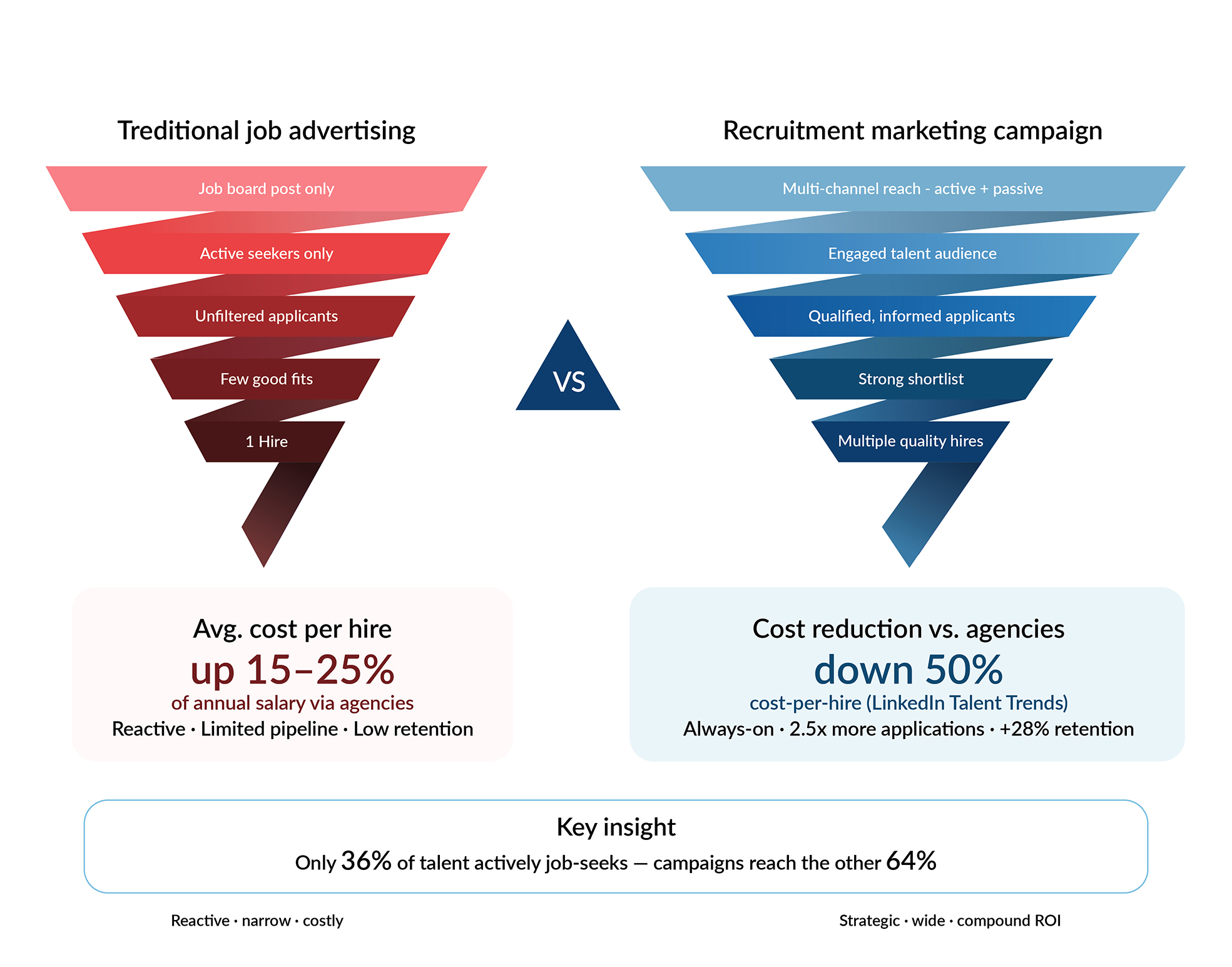
Only 36% of the global workforce actively looks for a new job at any given time. The other 64% — the passive talent pool — won’t find you through a job board. They’ll find you because your recruitment marketing campaigns showed up where they already spend their time. For talent acquisition leaders operating in a competitive hiring market, the question is no longer whether to invest in recruitment marketing — it’s whether you’re doing it well enough to win.
This guide walks you through every layer of building, running, and measuring recruitment marketing campaigns that actually fill roles — from setting your employer value proposition (EVP) to choosing channels, crafting content, and proving ROI to leadership.
What Are Recruitment Marketing Campaigns?
A recruitment marketing campaign is a planned, multi-channel effort to attract, engage, and convert potential candidates — before they ever submit an application. It borrows principles from B2B and B2C marketing: audience segmentation, content funnels, channel strategy, and performance analytics. The output is a warm, informed candidate pipeline rather than a cold applicant list.
The difference between traditional job advertising and a recruitment marketing campaign comes down to intent and structure:
| Dimension | Traditional Job Advertising | Recruitment Marketing Campaign |
|---|---|---|
| Goal | Fill a single open role | Build a continuous talent pipeline |
| Audience | Active job seekers only | Active + passive candidates |
| Channels | Job boards (LinkedIn, Naukri, Indeed) | Social, content, email, events, paid, organic |
| Message | Job description | Employer brand + role + culture story |
| Measurement | Applications received | Awareness → interest → apply → hire |
| Timeline | Reactive (role opens → post) | Always-on + role-specific bursts |
Well-executed campaigns treat candidates the way B2B marketers treat buyers — nurturing interest over time. That shift is what separates organisations that attract talent from those that merely receive applications.
Why Recruitment Marketing Campaigns Deserve a Dedicated Budget
HR leaders are often asked to justify marketing spend on hiring. The commercial case is straightforward when you look at the cost side of the ledger:
- Cost-per-hire through agencies: typically ₹1–3 lakh per hire at the mid-level in India, or 15–25% of annual salary internationally.
- Time-to-fill: averages 36–42 days across industries; high-demand tech roles routinely exceed 60 days.
- Quality of hire: passive candidates sourced through employer brand content have 2x higher retention at the 12-month mark compared to reactive applicants.
Companies with a strong employer brand see a 50% reduction in cost-per-hire and up to a 28% reduction in employee turnover. — LinkedIn Talent Trends
A recruitment advertising strategy that runs always-on employer brand content alongside role-specific bursts consistently outperforms one-off job posts — both on quality and on cost. For SMBs competing with larger employers for the same talent, it’s often the only sustainable way to win.
Building Your Recruitment Marketing Strategy: A 6-Step Framework
Before you launch a single campaign, you need a strategy. Without one, you’re spending money amplifying noise.
Step 1: Define Your Employer Value Proposition (EVP)
Your EVP is the core promise you make to potential employees. It answers: ‘Why would someone choose to work here over every other option?’ A credible EVP is specific, differentiated, and grounded in employee reality — not aspirational copy written in a boardroom.
Run internal surveys. Interview recent hires and top performers. Ask: what made you say yes? What surprised you? What keeps you here? The answers form your EVP pillars — typically 3–5 themes like career growth, culture, impact, flexibility, or compensation.
💡 Pro Tip: Validate your EVP with a short candidate survey before investing in campaign creative. If your stated EVP doesn’t resonate in testing, it won’t resonate in market.
Step 2: Build Candidate Personas
Not all roles recruit the same audience. A campaign targeting a senior data engineer looks nothing like one targeting a field sales consultant. Build personas that capture:
- Demographics and career stage
- Primary motivators (compensation, growth, impact, flexibility)
- Platforms they use actively (LinkedIn vs Instagram vs Naukri vs GitHub)
- Content formats they engage with (video, articles, peer reviews, podcasts)
- Objections and concerns about changing jobs
Step 3: Map the Candidate Journey
Borrow the marketing funnel. For each persona, map:
- Awareness: How does a passive candidate first encounter your brand? (LinkedIn post, Glassdoor review, referral, paid ad)
- Interest: What moves them from curious to engaged? (Employee story video, Glassdoor rating, culture blog post)
- Consideration: What helps them self-qualify? (Detailed JD, team structure, day-in-the-life content, benefits breakdown)
- Application: What removes friction at the conversion point? (Mobile-friendly form, under-60-second apply, clear timeline)
- Nurture: What keeps warm applicants engaged during a long process? (Status updates, culture content, hiring manager introductions)
Step 4: Choose Your Channel Mix
There is no universal channel strategy. The right mix depends on your personas, budget, and hiring volume. The table below maps channels to use cases:
| Channel | Best For | Avg. Cost-per-Click (India) | Passive Reach |
|---|---|---|---|
| LinkedIn Ads | Mid-senior professional roles | ₹150–₹400 | High |
| Meta (FB/Instagram) | Entry-level, blue-collar, consumer brands | ₹15–₹80 | Very High |
| Naukri / Indeed (Paid) | High-volume active sourcing | ₹50–₹200 per application | Low |
| Google Search Ads | Role-specific, high-intent searches | ₹80–₹250 | Low |
| Organic Social (LinkedIn/Instagram) | Employer brand, always-on content | Zero media cost | Medium |
| Employee Advocacy | Authentic reach into passive networks | Zero media cost | High |
| Career Site SEO | Long-term inbound sourcing | Zero media cost | Medium–High |
Step 5: Create Campaign Assets
Assets are the creative materials that carry your message across channels. Long-form campaigns need a content ecosystem — not a single ad:
- Hero content: 1–2 minute employer brand video. Film real employees. No scripts. No corporate voiceover.
- Short-form social: 15–30 second cut-downs for Instagram Reels, LinkedIn video, and YouTube Shorts.
- Employee spotlights: Written or video Q&As with team members across functions and levels.
- Day-in-the-life content: Authentic walk-throughs of specific roles — especially effective for technical and specialist positions.
- Culture infographics: Benefits, team size, L&D investment, DEI data — visual and shareable.
- Glassdoor and AmbitionBox strategy: Proactively respond to reviews. Aggregate genuine reviews from happy employees.
Step 6: Set KPIs Before Launch
Every campaign needs metrics defined before it goes live — not after you want to evaluate it. Align metrics to funnel stage:
| Funnel Stage | KPI | Benchmark Target |
|---|---|---|
| Awareness | Reach, Impressions, Brand search lift | Reach ≥ 5x your target talent pool size |
| Interest | Engagement rate, Video views (>50%), CTR | CTR > 1.5% (LinkedIn), > 0.8% (Meta) |
| Consideration | Career site visits, Time on page, Apply starts | Apply start rate > 40% of career page visits |
| Conversion | Applications submitted, Quality score | Cost-per-application < 3× job board benchmark |
| Post-hire | Offer acceptance rate, 90-day retention | Offer acceptance > 85%, 90-day retention > 90% |
Social Media Recruitment Marketing: Platforms, Tactics, and Content That Works
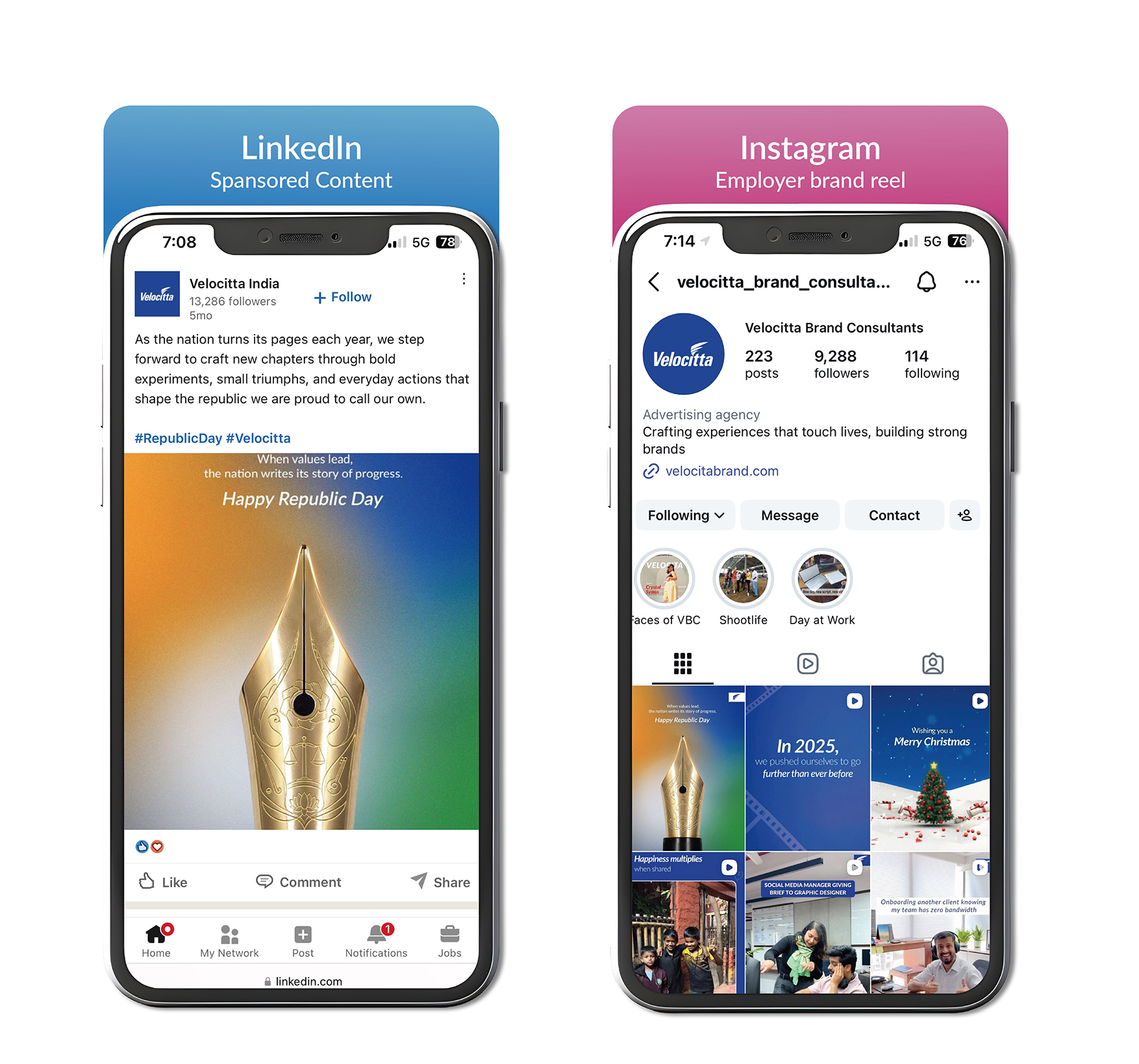
Social media recruitment campaigns have moved far beyond posting a job link on LinkedIn. Today, social media recruitment marketing is a full discipline spanning organic content strategy, paid targeting, employee advocacy programmes, and community building.
LinkedIn: The Professional Talent Hub
LinkedIn remains the dominant platform for professional hiring globally. But organic reach on company pages has declined — most posts reach fewer than 5% of followers without paid amplification. The highest-performing LinkedIn campaigns combine:
- Thought leadership posts from senior leaders — personal profiles have 5–10x the organic reach of company pages.
- Carousel posts showing team culture, office environments, or employee career journeys — strong saves and reshares.
- LinkedIn Talent Insights targeting for paid campaigns — allowing you to target by function, seniority, company, skill, and geography.
- InMail sequences for high-value passive candidates — personalised, role-specific outreach with <72-hour response windows.
Instagram and Meta: Reach the Passive Majority
For consumer-facing brands, retail, hospitality, and entry-to-mid level hiring, Meta platforms (Facebook and Instagram) offer unmatched passive reach at a fraction of LinkedIn’s cost per impression. The content format matters more here than the message:
- Instagram Reels showcasing office culture, team events, and day-in-the-life moments consistently outperform static posts by 3–5x on engagement.
- Facebook Groups remain surprisingly effective for local and blue-collar hiring — community-based organic posting reaches highly relevant audiences.
- Meta’s Advantage+ audience targeting, combined with look-alike modelling from your existing employee data, produces strong cost-per-application results for volume roles.
💡 Pro Tip: Build a ’30-day content bank’ before launching any social media recruitment campaign — so you can maintain posting consistency without burning out the team mid-campaign.
YouTube and Video: The Underutilised Channel
Search-intent video on YouTube is one of the most underutilised channels in talent acquisition advertising. Candidates actively search ‘what it’s like to work at [company]’, ‘day in the life [role]’, and ‘[company] culture review’ on YouTube. Pre-roll ads targeting viewers of competitor employer brand content can intercept passive candidates who are already in career exploration mode.
For specialist employer brand social media campaign execution — particularly for technology companies and B2B organisations — agencies like Velocitta Brands create integrated multi-platform strategies that align EVP messaging with platform-native content formats.
Talent Acquisition Advertising: Paid Media That Fills Pipelines
Paid talent acquisition advertising accelerates what organic and employer brand content builds over time. Used correctly, it adds precision targeting, speed, and scale. Used incorrectly, it burns budget on unqualified traffic.
Programmatic Job Advertising
Programmatic platforms (Appcast, Joveo, Veritone Hire) use real-time bidding to distribute job ads across hundreds of boards and sites — automatically shifting budget toward channels that produce applications, and pulling back from those that don’t. For high-volume hiring (50+ roles simultaneously), programmatic consistently outperforms manual job board posting on both volume and cost-per-hire.
Paid Social for Employer Branding
Unlike programmatic (which targets active seekers), paid social reaches passive candidates by interest, behaviour, and professional profile. The most effective formats:
- LinkedIn Sponsored Content: Native feed posts promoted to a defined audience. Use video for brand campaigns; single-image ads for specific role campaigns.
- LinkedIn Conversation Ads: Simulated Messenger-style experiences with multiple CTAs — effective for event registrations and high-touch role campaigns.
- Meta Lead Gen Ads: Candidates can express interest in future roles without leaving the app — excellent for building a pre-application talent pool.
- Google Discovery Ads: Passive exposure across Gmail, YouTube, and Google Discover — low cost-per-impression for brand awareness at the top of the funnel.
Retargeting: Close the Loop on Interested Candidates
Career site visitors who don’t apply are one of the highest-value audiences in recruitment advertising. Install a pixel on your career pages and run retargeting campaigns showing:
- Testimonial videos from employees in the team they browsed
- Specific role ads matching the job category they viewed
- Culture content addressing common candidate objections (‘Is remote work available?’, ‘What does career growth look like?’)
Retargeting consistently delivers the lowest cost-per-application of any paid channel — because you’re re-engaging an audience that has already signalled intent.
Best Recruitment Advertising Campaigns: What World-Class Looks Like
The best recruitment advertising campaigns share a common trait: they put the candidate experience first and the job requirement second. Here are four frameworks drawn from campaigns that generated measurable results:
The Challenge Campaign (GCHQ: ‘Can You Crack It?’)
The UK intelligence agency ran an encrypted puzzle online. Solving it was the application. This approach pre-qualified candidates by skill before they ever submitted a CV — screening 200,000 visitors down to 5,000 serious applicants. The lesson: make the campaign itself a demonstration of what working there requires.
- Applicable to: Tech companies, data teams, engineering roles, consulting firms. Any role where problem-solving is the core skill.
- Content formats: Interactive microsites, coding challenges, case study competitions.
The Product-Embedded Campaign (IKEA: Job Descriptions in Flat-Packs)
IKEA placed job advertisements inside furniture assembly instructions — reaching customers who were already brand advocates. The campaign generated 4,285 applications and 280 hires with near-zero media cost. The lesson: your existing customer and community touchpoints are often your best recruitment channels.
- Applicable to: Consumer brands, retail, hospitality, FMCG. Any company with a high-volume customer touchpoint.
- Content formats: Product packaging, receipts, delivery apps, loyalty programme emails.
The Data-Driven Always-On Campaign
Brother International rebuilt their recruitment marketing engine around analytics — tracking conversion at every funnel stage and using AI to personalise candidate outreach. The result: a 140% increase in completed applications. The lesson: optimisation compounds. A campaign that measures and adjusts outperforms a static campaign within weeks, not months.
- Key metrics tracked: Unique career site visitors, apply starts, completion rate, source attribution, time-to-apply.
- Tools typically used: ATS analytics dashboards, Google Analytics 4, LinkedIn Campaign Manager, programmatic DSPs.
The Employee Advocacy Campaign
Some of the most successful social media recruitment campaigns involve zero paid media. When employees share authentic content — team photos, project wins, career milestone posts — the reach and credibility far exceeds what a company page can achieve. At scale, structured employee advocacy programmes have generated millions of impressions per quarter at zero media cost.
- Implementation: Provide employees with ready-to-share content, a simple advocacy platform (LinkedIn Elevate, Bambu, EveryoneSocial), and recognition for participation.
- KPI: Employee-generated reach vs. company page reach. Aim for employee reach to be 3–5× company page reach within 6 months.
Recruitment Marketing Campaigns for SMBs: Doing More with Less
Mid-market and SMB hiring teams rarely have a dedicated recruitment marketing manager, a full creative studio, or a six-figure paid media budget. The good news: the highest-ROI tactics in recruitment marketing are not the most expensive ones.
Priority Stack for Budget-Constrained Teams
- Career page overhaul (Week 1–2): Your career site is your highest-converting real estate. A well-structured, mobile-optimised career page with team photos, culture copy, and a fast application form costs under ₹50,000 to improve and pays back immediately.
- Glassdoor and AmbitionBox (Week 2–3): Claim and actively manage your profiles. Respond to every review — positive and negative. Candidates check these before applying. Your response rate signals employer responsiveness.
- LinkedIn company page (Week 3–4): Post 3x per week minimum — team updates, employee spotlights, industry insights. No budget required. Consistency compounds into follower growth and organic reach.
- Employee referral programme (Month 2): Structured referral programmes are the single highest-quality candidate source for most SMBs. A ₹10,000–₹25,000 referral bonus for a successful hire is far cheaper than an agency fee.
- Targeted LinkedIn paid campaigns (Month 2–3): Start with ₹30,000–₹50,000/month. Narrow your audience to a specific persona + geography + function. Measure CPL and application rate weekly. Double down on what works.
💡 Pro Tip: Repurpose every piece of content across channels. One employee video = LinkedIn post + Instagram Reel + YouTube Short + career site feature + email nurture touchpoint. You don’t need more content — you need better distribution.
Measuring Recruitment Marketing Campaign Performance: The Metrics That Matter
Campaign measurement in talent acquisition is often limited to ‘how many applications did we get?’ That single metric tells you almost nothing about campaign quality or efficiency. A robust measurement framework covers the full funnel:
Top-of-Funnel: Brand Awareness
- Branded search volume (track month-over-month via Google Search Console)
- Career page organic traffic from non-branded keywords
- Social media reach and follower growth rate
- Glassdoor / AmbitionBox profile views
Mid-Funnel: Candidate Engagement
- Apply start rate (career page visitors who begin an application)
- Application completion rate (started vs submitted)
- Email open and click rate for candidate nurture sequences
- Time-on-page for key career site content
Bottom-of-Funnel: Conversion and Quality
- Cost-per-application by channel (compare monthly)
- Application-to-interview ratio (quality signal)
- Interview-to-offer ratio
- Offer acceptance rate
- Source-of-hire attribution
Post-Hire: Long-Term ROI
- 90-day retention rate by source
- 12-month retention rate by source
- Performance rating at 6 months (if available)
- Net Promoter Score (NPS) among new hires at 30/60/90 days
The goal is not to track everything — it’s to track the metrics that connect campaign investment to hiring outcomes. Source-of-hire + 12-month retention = the ROI story your CFO will understand.
For further reading on connecting recruitment analytics to business outcomes, see LinkedIn’s annual Talent Trends report — one of the most comprehensive annual datasets on global hiring patterns and recruiter investment priorities.
Recruitment Marketing Campaign Launch Checklist: 10 Steps Before You Go Live
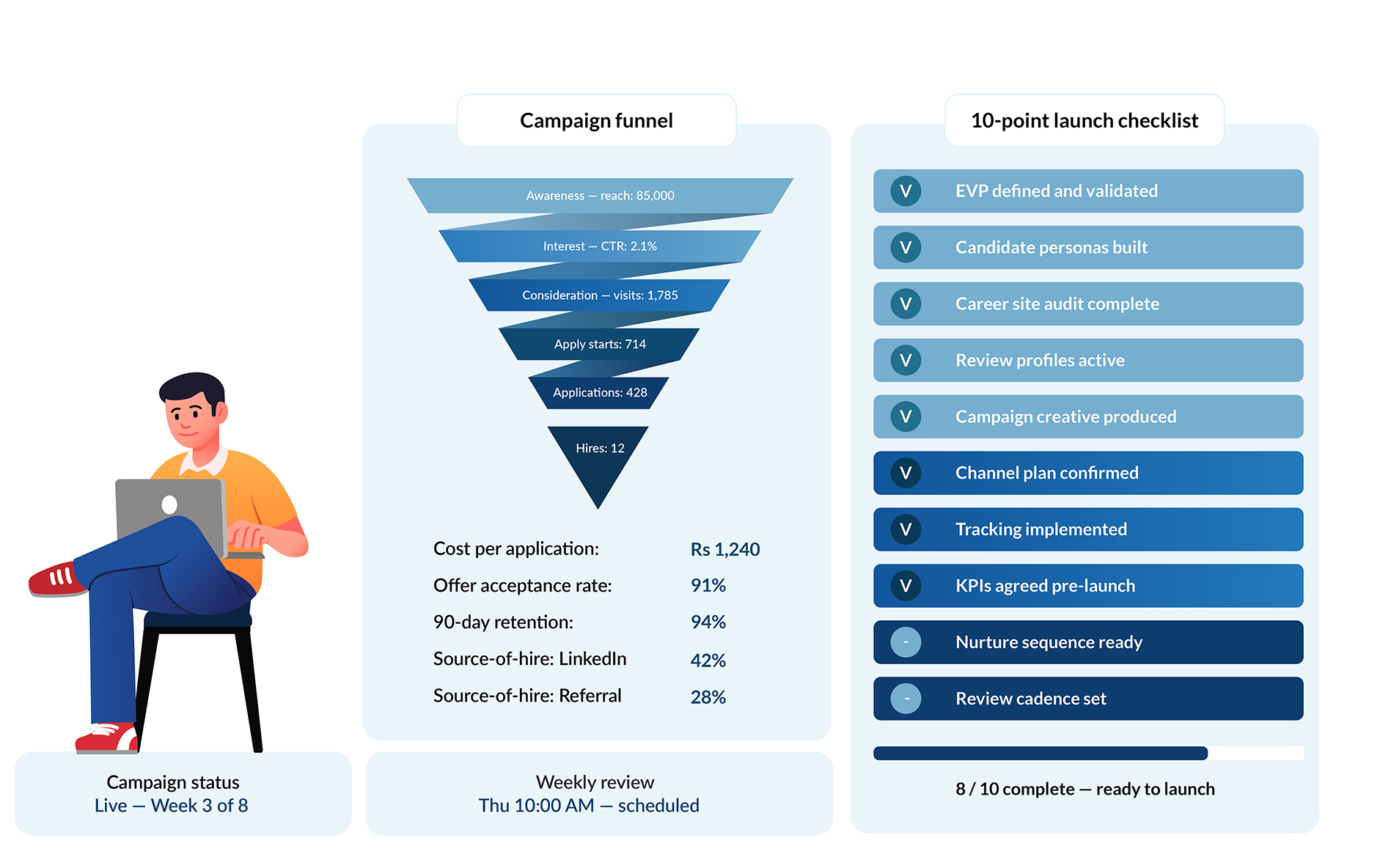
Use this checklist before launching any recruitment marketing campaign — whether it’s a single role push or an always-on employer brand programme:
- EVP defined and validated. Employee surveys or interviews completed. EVP pillars documented.
- Candidate persona(s) built. Demographics, motivators, channel preferences, and objections mapped for each target segment.
- Career site audit completed. Mobile responsiveness tested, page speed optimised, apply form under 5 minutes to complete.
- Review profiles claimed and active. Glassdoor, AmbitionBox, and LinkedIn company page updated, recent reviews responded to.
- Campaign creative produced. Video, imagery, and copy assets ready for all planned channels and formats.
- Channel plan confirmed. Paid and organic channels selected, budgets allocated, targeting parameters set.
- Tracking implemented. UTM parameters on all paid links, pixel installed on career site, GA4 goals configured.
- KPIs agreed. Funnel-stage metrics defined and shared with stakeholders before launch — not after.
- Candidate nurture sequence ready. At minimum, an automated confirmation email and a 3-touch follow-up sequence for applicants who don’t complete.
- Review cadence set. Weekly 30-minute campaign review scheduled. Budget reallocation process agreed. Optimisation decisions documented.
Common Recruitment Marketing Mistakes (And How to Avoid Them)
| Mistake | Why It Fails | What to Do Instead |
|---|---|---|
| Starting without an EVP | Campaign creative is generic and fails to differentiate from competitors | Run employee research first; build EVP on real insights |
| Treating all channels identically | Content that works on LinkedIn is wrong for Instagram and irrelevant on Naukri | Build platform-native content for each channel |
| Measuring only applications | High application volume masks poor quality and wasted spend | Track cost-per-application AND interview rate AND 90-day retention |
| Campaign in isolation from CX | Strong top-of-funnel killed by a broken application form or slow response | Audit candidate experience from click to offer before launch |
| One-time campaign, not always-on | Employer brand erodes between bursts; pipeline dries up | Maintain a base layer of always-on content between role-specific pushes |
| No employee involvement | Brand looks polished but inauthentic; candidate trust is low | Co-create content with employees; activate advocacy at launch |
How Velocitta Brands Supports Employer Brand-Led Recruitment Campaigns
Building recruitment marketing campaigns that genuinely attract the right talent requires more than a job post or a boosted LinkedIn update — it requires a coherent employer brand strategy, platform-native creative execution, and the discipline to measure what matters. Velocitta Brands works with HR and talent acquisition teams to design integrated campaigns that connect EVP to content to channel — building the kind of authentic digital presence that draws candidates in rather than interrupting them.
From employer brand social media programmes to large-scale multi-platform talent campaigns for leading technology organisations, Velocitta brings strategic rigour and creative execution together under one roof — so your recruitment marketing investments translate into hires, not just impressions.
Key Takeaways
- Recruitment marketing campaigns out-perform reactive job posting because they reach passive candidates, build pipeline before roles open, and reduce cost-per-hire over time.
- Your EVP is the foundation: no campaign creative can compensate for a value proposition that isn’t grounded in genuine employee insight.
- Channel selection must follow persona: LinkedIn for professional roles, Meta for volume and consumer brands, YouTube for passive employer brand awareness. One channel does not fit all roles.
- Measurement beyond application count is non-negotiable: source-of-hire + interview rate + 12-month retention is the ROI equation that wins budget conversations with leadership.
- SMBs can compete: career site quality, Glassdoor management, LinkedIn consistency, and structured employee referral programmes are high-ROI and low-cost — start there before spending on paid media.
Frequently Asked Questions
Employer branding is the long-term strategy of defining and communicating what it’s like to work at your organisation. Recruitment marketing is the tactical execution that activates that brand through specific campaigns, channels, and content to attract candidates for current and future roles. Employer branding is the foundation; recruitment marketing is the mechanism that puts it to work.
There is no universal benchmark, but a practical starting point for mid-market companies is 10–15% of total recruitment budget allocated to marketing. For a company spending ₹50 lakh annually on agency fees and job boards, that translates to ₹5–7.5 lakh for employer brand content and paid social — a reallocation rather than an addition. As campaigns demonstrate lower cost-per-hire, the business case for increasing the marketing proportion grows.
LinkedIn is the default for professional and managerial hiring. Instagram and Facebook outperform on reach and cost for entry-level, blue-collar, and consumer brand roles. YouTube is underutilised but highly effective for passive talent at the awareness stage. The right answer depends on your personas — map where your target candidates spend time before committing budget to any platform.
Always-on employer brand campaigns typically take 3–6 months to build measurable organic reach and Glassdoor momentum. Role-specific paid campaigns can generate applications within days of launch. The most effective approach layers always-on brand content (long-term) with role-specific paid bursts (short-term) — the brand foundation improves the performance of every individual campaign over time.
Lead with cost-per-hire by source, quality-of-hire (interview rate from campaign traffic vs. job board), and 90-day retention rate. Secondary metrics for a quarterly review: career site organic traffic growth, Glassdoor rating trend, and offer acceptance rate. These translate directly to financial impact — reduced agency spend, lower time-to-fill, and reduced early attrition costs.